

UNCONDITIONED CHAPTER 1
The Foreboding

The last time I saw my mother she hugged me and I pulled away.
Propped up in a hospital bed surrounded by her family, her face benevolently introspective, my mother’s eyes twinkled like the Dalai Lama’s. She’d avoided open-heart surgery for twenty years and suddenly welcomed it with equanimity. I wondered what drugs they’d given her.
When it was time to leave, one-by-one the family approached my mother to wish her well. I was last and sat on the edge of the bed to lean in for a hug. For the first time in my life, a loving expression was directed at me. She grabbed onto me and held me so tightly that I recoiled. With the history we shared, her demonstration of love was impossible to trust. I retreated into my familiar internal well of safety, and though physically I still sat on her bed, emotionally I had slipped away. At forty-one, the idea of compassion was too cerebral. Had this occurred ten years later I would’ve been able to reciprocate. But at that moment I needed to protect myself.
While my heart was guarded, my mother’s was too weak to overcome the stress of valve replacement and she was put on life support soon after the surgery. Her prognosis was bleak, but she was kept alive for three months. My father, compulsive in his routines, didn’t like change. He’d already made an adjustment when my mother left their condo to have surgery. He resisted the bigger adjustment of her inevitable death by pretending she would wake up any moment and be all better.
When my son Jesse came home from university for Christmas, the two of us drove from New Hampshire to Ontario to meet with my siblings, their spouses, and my mother’s medical team. We needed to convince my father it was time to let her go. He shook his head no and stared into his lap as he was being told she no longer had brain activity or any chance of recovering. For the past two months he’d established a new routine and clung to it. My father had controlled every aspect of my mother’s life for fifty-four years. Her death would happen on his terms.
Before we headed home, Jesse and I said our goodbyes as the ventilator forced air in and out of my mother’s vacant form. Jesse’s relationship with my parents was tender, so he had a lot more to say to her than I did. He’s a sensitive, open-hearted man who embraced my parents’ eccentricities with affection and they and I adored him for it. When he was done, he turned to the window and wept while I leaned close to her ear and said softly, “Goodbye, Mom. I love you.” I kissed her forehead and then, uneasy with absorbing any part of her, quickly wiped my lips with the backs of my hands, relieved that Jesse faced the other way and couldn’t see what I’d done.
When the life support system had run its course toward the end of January, my father was forced to relent. I felt unchanged by the news of her death and shed no tears. It was sad her life ended that way and that she’d waited so long to express love, but it had been too brief and too late. Thanks to the rigors of recent therapy, I understood why she’d treated me the way she had. However, emotionally my healing was just beginning to take root.
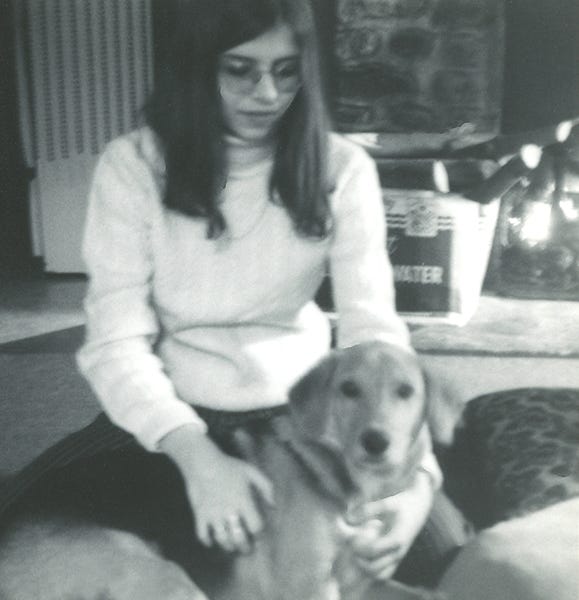
The grief I felt for my dog Guido when he died eight years earlier was different. He’d been my constant companion since I left home at eighteen. I held him while the vet administered the shot. As his body went limp, a rush of energy passed through me, which felt like an internal farewell caress from him. I pined for weeks afterwards, my heart aching with loneliness.
Those offering condolences said, “Losing your mother is the most difficult thing in life no matter how old you are.” I’d nod and agree, imagining how wonderful it would be to feel that way.
****
When I was three, my mother gave away my first dog as though she were taking out the trash.
We’d moved to a suburb of Boston from a poultry farm in Westport, Massachusetts close to where my parents grew up. Seeing no future in chickens, my father, Lou, got a more promising job as a machinist at Raytheon and sold the farm. My mother, whose name was Palmina and called Pal, was a full-time homemaker. Our apartment was sparse. My brother, Lou, thirteen, and sister, Vivian, nine, shared a bedroom. I slept in a crib in my parents’ room until I was five.
My mother spent hours sitting on the couch staring straight ahead, biting her nails, legs crossed, one kicking madly. Other than her honeymoon in New York, she’d never been away from her family, so she was a bundle of nerves after the move. With my father at work and my siblings at school, the days stretched long and boring. It was impossible to get through to my mother when she sank into that mood. Instead, I talked to my German shepherd, ChiChi.
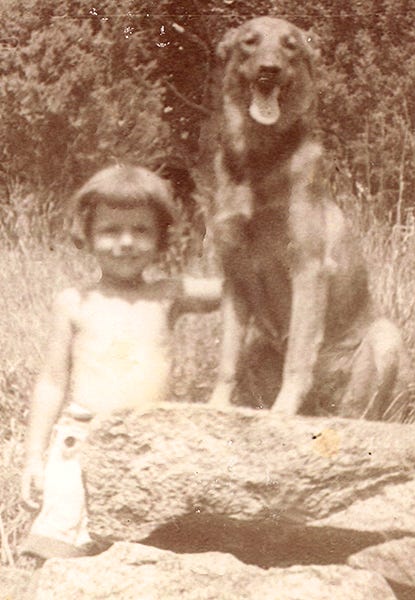
One day the stilted afternoon was interrupted by the first time anyone had knocked on our front door. ChiChi moved to sit in front of me and I watched through her large pointy ears as my mother let in a strange man carrying a leash. My mother stomped toward us and dragged ChiChi by the collar over to the stranger.
“What are you doing?”
The man clipped the leash onto ChiChi’s collar and pulled my only friend out the door as she resisted with all her strength, jerking her head and stretching out her legs because I was crying and she wanted to protect me.
“Where is that man taking ChiChi?”
“We can’t keep that big dog in the city.”
“ChiChi’s my dog. You can’t give her away. Get her back. Please,” I choked in panic.
“Stop it or I’ll give you somethin to cry about,” was my cue this conversation was over. We each retreated into separate worlds. Tears from an unfamiliar source, one that felt endless, streamed down my cheeks while I stared at my coloring book pretending to fill in the empty spaces. I slipped into a numbness that would soon become familiar. The coldness revealed by my mother’s disposal of a family member and the lack of empathy for my heartbreak unnerved me, leaving me dazed by a harsh perception: my life could change instantly, I was powerless, and my mother didn’t care about me. This was when the foreboding began.
Coming on February 12!
Chapter 2 The Shit Hits the Fan jumps forward thirty years to the mess that was a seed planted into the darkness of my circuitous journey.
She did the best she knew how to do. Thank you for sharing your truth.
As someone who's ancestors were slaves I was beaten with switches from bushes and leather belts. When you wrote "Stop it or I’ll give you somethin to cry about,” the memories came flooding in.
The blessing is that after many years of therapy and spiritual work I forgave my mother and my grandmother, the 2 people I was beaten by.
Heartwrenching opening. The grief at losing a pet, especially a dog, leaves us devastated, and I can only imagine how you must have felt being left alone with your mother after your beloved dog was taken away. I had a mother like yours. She was emotionally absent, a total narcissist, and the impact on me was incredibly destructive. But now, we are survivors, and thriving big time :-)